


Hard black rules, flat pink, no gradients anywhere. A shelf that deals itself out and closes on a sale.
What VideoFlow makes from real products.
Five films, each one generated from nothing but that company's public website. Unofficial concepts, no endorsement implied — and no two of them built from the same plan.
Bring your own brain.
VideoFlow Studio is the harness — it plans the shots, drives the renderer, reviews the result and gives you somewhere to keep directing it. The intelligence is whichever coding agent you already pay for.
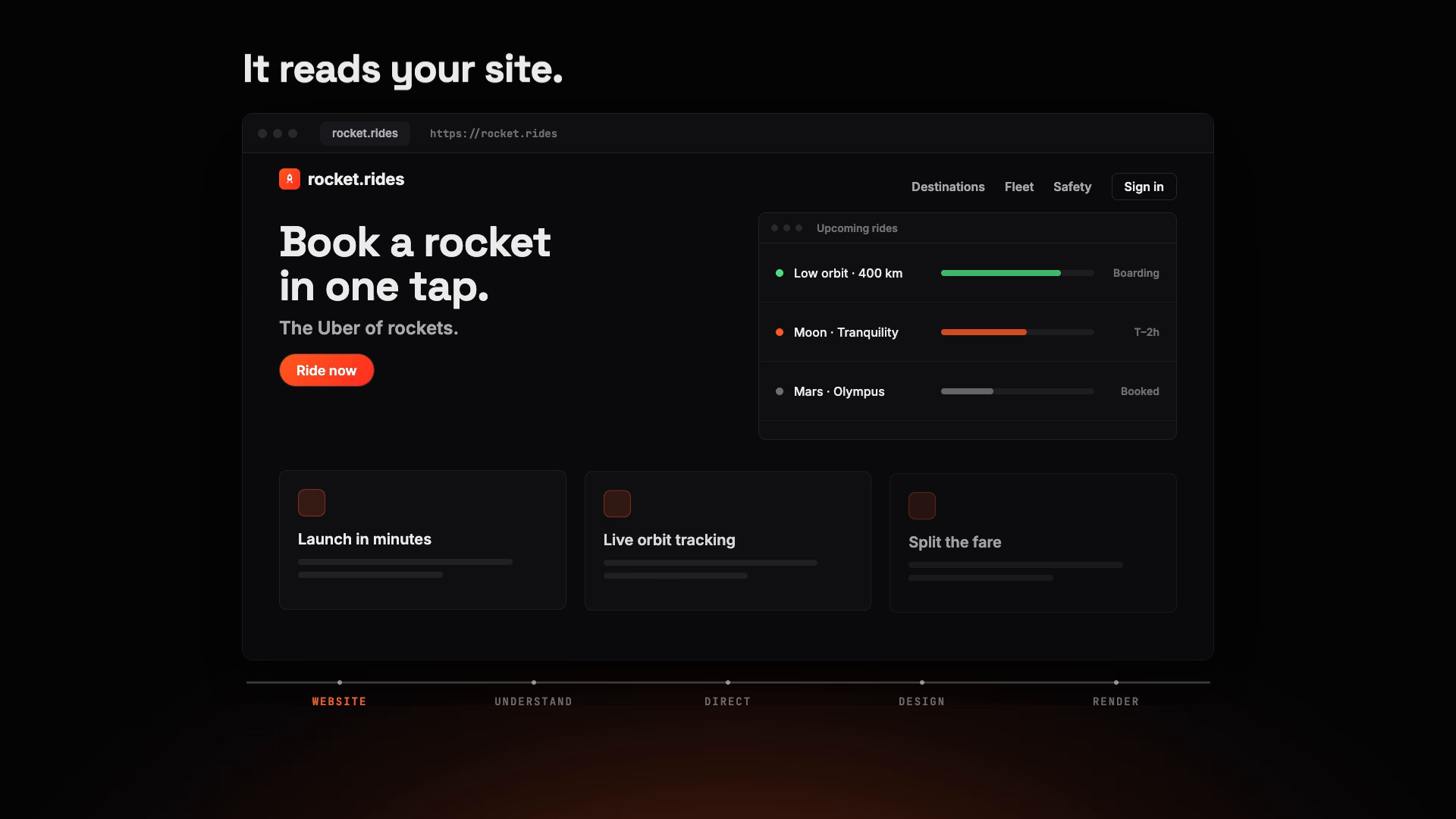
From website to finished film.
Five stages, one set of objects. Watch what the site turns into.
Edit with AI, or the VideoFlow Editor.
A first render is a starting point, not a final answer. Both of these work on the exact film the agent just built — nothing to re-export, nothing to reconnect.
Say it in a sentence
The same agent that built the film reads your request against the plan it already made, and re-renders — not a generic prompt box, a director with the context still warm.
The built-in video editor
Every film is a portable document, not a locked render. Drag a layer, retime a cut, swap a colour, rewrite a headline — and the agent picks your changes up on its next pass instead of overwriting them.
Sharp at any size. Editable forever.
Studio doesn't guess what a frame should look like — it draws it. Every shape, every letter, every move is real, exact data, drawn by VideoFlow, the open-source rendering engine underneath Studio. Nothing is dreamed up pixel by pixel, so nothing needs fixing after the fact.
- Actually sharp. Zoom in, crop it, export it at 4K — it was never a blur to begin with.
- Actually consistent. No warped logos, no melting text, no frame that quietly breaks the brand.
- Actually editable. The film stays a real document, so you — or the agent — can still open it and change it.
Your video gets visually reviewed.
A render isn't the last step. The agent watches the finished film back, measures what the eye alone can't check, fixes what's wrong and renders it again — before you see it.
It watches the render
Not the code that made it — the encoded frames, the way a viewer would see them.
It measures what it sees
A subhead off the type axis by 38px. A button at 1.9:1 against its own background.
It fixes it and renders again
Before you ever open it. The version you get is the one that already passed.
Not a template.
Nothing here comes from a library of pre-built intros. The agent reads the product first — its category, its brand, the one feature worth building a scene around — and designs a visual system from that. Three real plans, three results that don't share a grid, a palette, or a rhythm, because none of them started from the same brief.
Planes of API surface sliding through each other, one request travelling the whole depth of the stack.
One issue crossing three lanes without a cut. The carried object is the issue itself.
Direct it from your terminal.
Say what you want changed in a sentence. The agent re-cuts the scene and re-renders it.
$ npx @videoflow/studio
Why VideoFlow wins.
For the specific job of generating motion graphics agentically, from a URL, with no human in the loop, nothing else is built to do the whole thing end to end, openly licensed, and checked before it reaches you.
- Open-source engine. Apache-2.0, no per-render fee and no company-size threshold that triggers a commercial licence.
- A harness, not a library. It plans, builds and reviews the whole film — you're not writing scene code or requesting a tweak at a time to get somewhere.
- Portable. A structured document, not a compiled program — checkable, diffable, and editable after the fact.
- Editable, then editable again. Open it in the video editor, ask for another change in plain language, export as many times as you want.
- It reviews itself. The agent watches the rendered film and corrects what it finds, automatically, before it reaches you.
vs. Remotion
React components an agent has to get right versus a document it can check before it ever renders, and what that costs at automation scale.
Read the comparison →vs. HyperFrames
Two HTML-native, agent-first engines. What differs is not the renderer, it is the review pass that runs before a film ships.
Read the comparison →Make your startup move.
Free to start — 4 renders and edits a month, on your own Claude Code or Codex subscription.